Overview
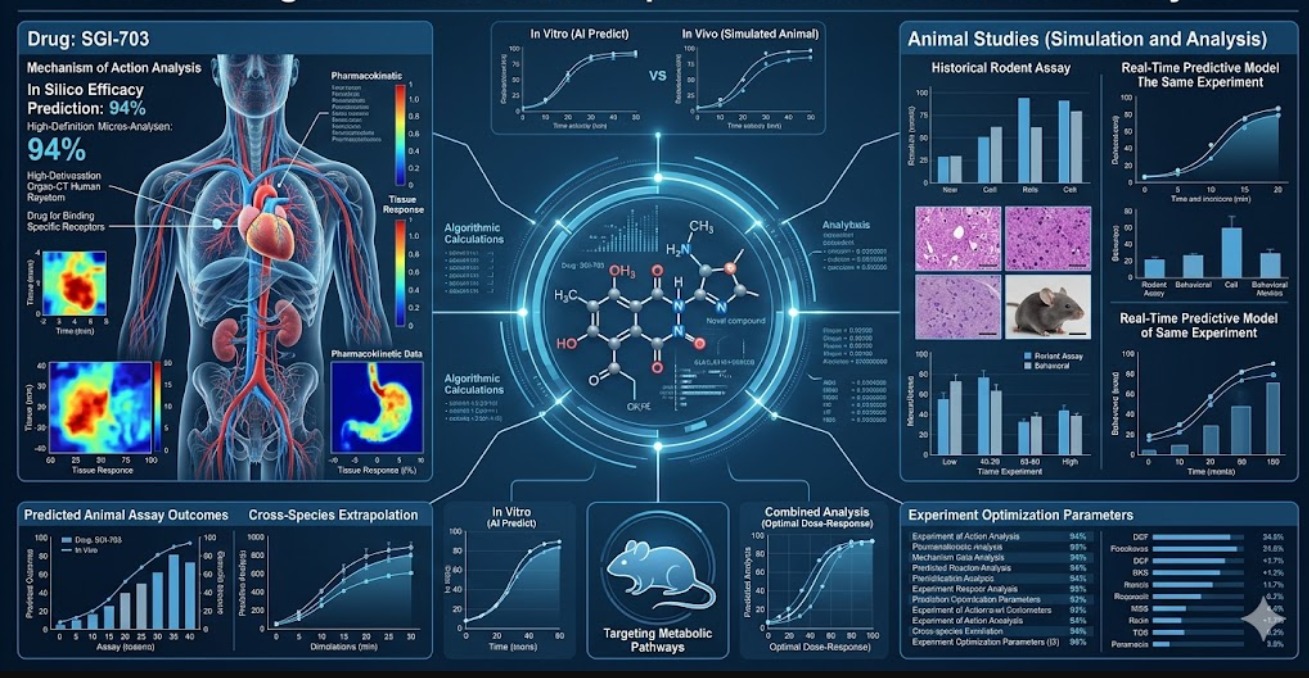
Traditional experimental pharmacology has long relied on resource-intensive in vivo and in vitro models to evaluate drug safety and efficacy. However, the integration of Artificial Intelligence (AI) is revolutionizing this workflow by transforming the laboratory from a primary discovery site to a targeted validation center. This abstract explores the synergy between computational intelligence and physical experimentation in modern pharmacological research.
The application of Machine Learning (ML) and Deep Learning (DL) algorithms now allows researchers to predict pharmacological outcomes—such as LD50 values, binding affinities, and ADMET profiles—before a single animal is handled. By utilizing tools like Quantitative Structure-Activity Relationship (QSAR) modeling and AI-driven molecular docking, pharmacologists can narrow down thousands of lead compounds to a select few high-probability candidates. This "AI-first" approach directly supports the 3Rs principle (Replacement, Reduction, and Refinement) by significantly reducing the number of laboratory animals required for screening.
Our Trainers

Dr. Seema Sharma
Dr. Seema Sharma
Associate Professor
Indore,MP

Dr. Ajay Singh Kushwah
Dr. Ajay Singh Kushwah
Professor & HOD
Department of Pharmacology
Amar Shaheed Baba Ajit Singh Jujhar Singh Memorial College of Pharmacy Bela, Ropar, Punjab,India

Gautam Gehani
Mr. Gautam Gehani
Assistant Professor
Department of Pharmacology
Mittal Institute Of Pharmacy Bhopal

Dr. Avinash Singh Madloi
Dr. Avinash Singh Mandloi
Professor
Department of Pharmacology
VNS College of Pharmacy,Bhopal

Dr. Shamsher Singh
Dr. Shamsher Singh
Professor & HOD
Department of Pharmacology
ISF College of Pharmacy,Moga Punjab

Dr. Shamsher Singh
Dr. Shamsher Singh
Professor & HOD
Department of Pharmacology
ISF College of Pharmacy,Moga Punjab
Modules
1: Introduction to AI in Pharmacology
Duration: 3–4 hours
Content:Basics of Artificial Intelligence and Machine Learning
Role of AI in drug discovery and development
Overview of experimental pharmacology
Importance of integrating AI with biological studies.
Learning Outcome:Participants will understand the fundamentals of AI and its relevance in pharmacology
2: In Silico Techniques in Drug Discovery
Duration: 5–6 hours
Content:Molecular docking and simulation
QSAR (Quantitative Structure–Activity Relationship)
Virtual screening techniques
ADMET prediction (Absorption, Distribution, Metabolism, Excretion, Toxicity)
Databases and tools (e.g., AutoDock, PubChem, SwissADME)
Practical Session:Hands-on molecular docking demonstration
Learning Outcome:Participants will gain skills in computational drug prediction methods.
3: AI Tools and Applications
Duration: 4–5 hours
Content:Machine learning models in pharmacology
Deep learning applications in drug discovery
AI for target identification and biomarker discovery
Case studies of AI-driven drug development
Practical Session:Introduction to AI-based platforms and software.
Learning Outcome:Participants will be able to apply AI tools in pharmacological research.
Outcomes
1. Understand the fundamental concepts of artificial intelligence (AI) and its applications in experimental pharmacology, including machine learning and data-driven drug discovery.
2. Explain the principles and methodologies of in silico techniques such as molecular docking, QSAR modeling, and virtual screening in predicting pharmacological activity.
3. Demonstrate the ability to utilize AI-based tools and software for drug target identification, lead optimization, and toxicity prediction.
4. Analyze and interpret computational results and correlate them with in vivo experimental data for validation of pharmacological effects.
5. Evaluate ethical considerations, limitations, and regulatory aspects associated with the use of AI in pharmacological research.
6. Apply interdisciplinary approaches combining pharmacology, bioinformatics, and AI for innovative research problem-solving.