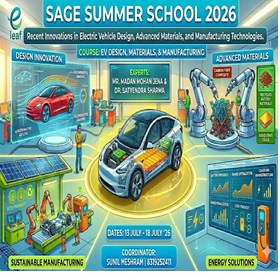
Overview
The Summer School Program aims to enhance participants’ knowledge of recent innovations in electric vehicle (EV) design, advanced materials, and modern manufacturing technologies. It focuses on developing technical competence in battery systems, lightweight materials, and sustainable production methods. The course intends to bridge the gap between academia and industry by introducing emerging trends, safety standards, and regulatory frameworks in electric mobility. It also encourages research-oriented thinking and innovation among participants. Ultimately, the program prepares faculty and researchers to address future challenges and opportunities in clean, efficient, and sustainable transportation systems, contributing to the advancement of next-generation electric vehicles.
Our Trainers

Mr. Madan Mohan Jena
Mr. Madan Mohan Jena is an accomplished engineering professional and an alumnus of SAGE University, Indore. He is currently serving as a Senior Manager – Product Engineering at Daimler India Commercial Vehicles, Chennai, Tamil Nadu.
With extensive experience in the automotive sector, he specializes in product design, development, and engineering innovations, particularly in commercial vehicle systems. Over the years, he has contributed significantly to advanced engineering solutions, quality improvement, and efficient product lifecycle management.
Mr. Jena brings strong industry insight combined with technical expertise, making him a valuable contributor to discussions on modern vehicle design, emerging technologies, and manufacturing practices.
Modules
1. Fundamentals of Electric Vehicle Systems
- Introduction to EV architecture (BEV, HEV, PHEV)
- Components: motor, controller, battery, drivetrain
- Comparison with conventional vehicles
- Performance parameters and energy efficiency
2. Battery Technologies and Energy Storage Systems
- Types of batteries (Li-ion, Solid-state, etc.)
- Battery Management System (BMS)
- Charging technologies and infrastructure
- Thermal management and safety issues
3. Electric Powertrain and Control Systems
- Electric motors (BLDC, PMSM, Induction Motor)
- Power electronics and converters
- Control strategies and drive systems
- Regenerative braking systems
4. Advanced Materials for Electric Vehicles
- Lightweight materials (composites, aluminum alloys)
- Nanomaterials and smart materials
- Material selection criteria for EVs
- Sustainability and recyclability of materials
5. Modern Manufacturing Technologies in EV
- Additive manufacturing (3D printing)
- Automation and Industry 4.0
- Lean and green manufacturing
- Quality control and production optimization
6. Safety Standards, Regulations, and Lifecycle Assessment
- EV safety standards and testing
- Government policies and regulations (India & global)
- Environmental impact and lifecycle assessment (LCA)
- Future trends and challenges in EV adoption
Outcomes
Course Outcomes
- Understand EV Fundamentals:
Participants will be able to explain the architecture, components, and working principles of electric vehicles and their advantages over conventional systems. - Analyze Battery & Energy Systems:
Participants will gain the ability to evaluate different battery technologies, charging methods, and battery management systems used in EVs. - Apply Advanced Materials Knowledge:
Participants will be able to identify and select suitable lightweight and sustainable materials for improving EV performance and efficiency. - Evaluate Manufacturing Technologies:
Participants will understand modern manufacturing practices such as additive manufacturing, automation, and Industry 4.0 in EV production. - Assess Safety, Regulations & Sustainability:
Participants will be able to interpret EV safety standards, regulatory frameworks, and perform basic lifecycle assessment for sustainable mobility solutions.
FAQs
1. Why is knowledge of Electric Vehicles important for students?
Electric Vehicles are the future of transportation due to their environmental and economic benefits. Understanding EV technology helps students stay relevant in rapidly evolving automotive and energy sectors.
2. How will this course help in career opportunities?
This course opens career paths in EV manufacturing, battery technology, renewable energy, automotive design, and research organizations, which are growing globally.
3. What practical skills will students gain from this course?
Students will learn about EV components, battery systems, advanced materials, and modern manufacturing techniques, enabling them to apply concepts in real-world engineering problems.
4. How does this course support sustainability awareness?
The course emphasizes clean energy, reduced emissions, and lifecycle assessment, helping students understand sustainable engineering practices and environmental responsibility.
5. Why is it important to understand EV safety and regulations?
Knowledge of safety standards and government regulations ensures students can design and work on EV systems that are safe, compliant, and industry-ready.