Overview
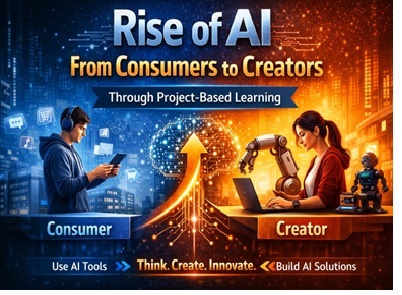
The objective of this program is to transform students from AI users into AI builders by providing a strong foundation in Artificial Intelligence, Prompt Engineering, API integration, and full-stack AI application development. By the end of the program, participants will design and deploy a ChatGPT-like AI application.
Our Trainers

Aman Pandey
1. 4+ years
2. CEO, CODEWAVE Solutions
3. Software Developer, AI Engineer
Modules
Day 1: Introduction to AI & Industry Landscape
Fundamentals of Artificial Intelligence, Machine Learning, and Deep Learning
-
- Distinction between AI, ML, and DL
- Conceptual hierarchy and real-world relevance
- Types of Artificial Intelligence
- Narrow AI vs General AI
- Industry Applications
- Use cases in healthcare, finance, education, and automation
Day 2: Foundations of Generative AI
- Generative AI vs Traditional AI systems
- Introduction to Transformers (conceptual overview)
- Tokens and their role in text processing
- Embeddings and semantic representation
Activity:Generate content such as blogs, code snippets, and creative text using AI tools
Mini Project Task:
Utilize AI tools to generate domain-specific responses aligned with the assistant idea.
Day 3: Understanding Large Language Models (LLMs)
- Training vs Inference processes
- Data dependency and bias in AI models
- Hallucination in AI outputs
- Limitations and ethical considerations
Activity:
- Comparative analysis of high-quality and poor prompts
- Identification of hallucinated or incorrect responses
Mini Project Task:
Enhance response accuracy through improved instruction design.
Day 4: Prompt Engineering (Beginner)
- Structure of an effective prompt
- Role definition
- Task clarity
- Context inclusion
- Output formatting
- Zero-shot and Few-shot prompting techniques
Activity:
- Creation of prompts for teaching, coding, and content generation tasks
Mini Project Task:
Design the foundational prompt structure for the AI assistant.
Day 5: Prompt Engineering (Advanced)
- Chain-of-thought prompting
- Role-based prompting
- Iterative refinement of prompts
- Structured output generation
Activity:Transforming basic prompts into optimized, high-performance prompts
Mini Project Task:
Develop a structured prompt system tailored to the assistant’s functionality.
Day 6: AI for Developers (API Integration)
- Fundamentals of APIs
- Request-response lifecycle
- JSON data structure
- API authentication and security
Activity:
- Executing initial API calls using development tools or code
Mini Project Task:
Develop a command-line based chatbot using API integration.
Day 7: Backend Integration
Introduction to Node.js
- Express.js framework
- REST API development
- Request and response handling
- Middleware and routing basics .
Activity:
- Creation of a chatbot API endpoint
Mini Project Task:
Develop the backend architecture for the chatbot.
Day 8: Frontend Development Basics
- Introduction to React
- Component-based architecture
- State and props management
- Event handling and UI structuring
- Basic styling and layout design
Activity:
- Development of a chat interface with input/output components
Mini Project Task:
Create a functional and interactive chat UI for the assistant.
Day 9: Full-Stack Integration & Functionality
- API communication using Fetch/Axios
- Asynchronous programming (async/await)
- Handling API responses and errors
- Data flow between UI and server
Activity:
- Integration of frontend with backend APIs
Mini Project Task:
Develop a working chatbot with real-time AI responses.
Day 10: Chatbot UX & Context Handling
- Chat flow and conversational design
- Typing indicators and loading states
- Context window and token limitations
- Managing conversation history
Activity:
- Implement typing effects and conversation tracking
Mini Project Task:
Enable multi-turn conversation with enhanced UX.
Day 11: Advanced AI Features & Customization
- System prompts and behavior control
- Role-based assistants
- Personalization techniques
- Output formatting and response control
Activity:
- Development of specialized assistants (e.g., coding assistant, teaching assistant)
Mini Project Task:
Build and integrate a customized AI assistant feature.
Day 12: Deployment & Final Integration
- Frontend deployment (Vercel)
- Backend deployment (Render)
- Environment variable configuration
- Debugging and final integration checks
Activity:
- Deployment of the complete AI application
Mini Project Task:
Publish a live version of the chatbot.
Day 13: Product Enhancement & Real-World Implementation
- Feature enhancement and optimization
- Adding advanced capabilities (e.g., summarization, resume generation, coding assistance)
- Error handling and fallback responses
- Performance tuning and usability improvements
Activity:
- Enhancement of the chatbot with additional features
Final Task:
Upgrade the application into a specialized AI product (e.g., AI Career Assistant, AI Learning Assistant, AI Coding Mentor).
Outcomes
|