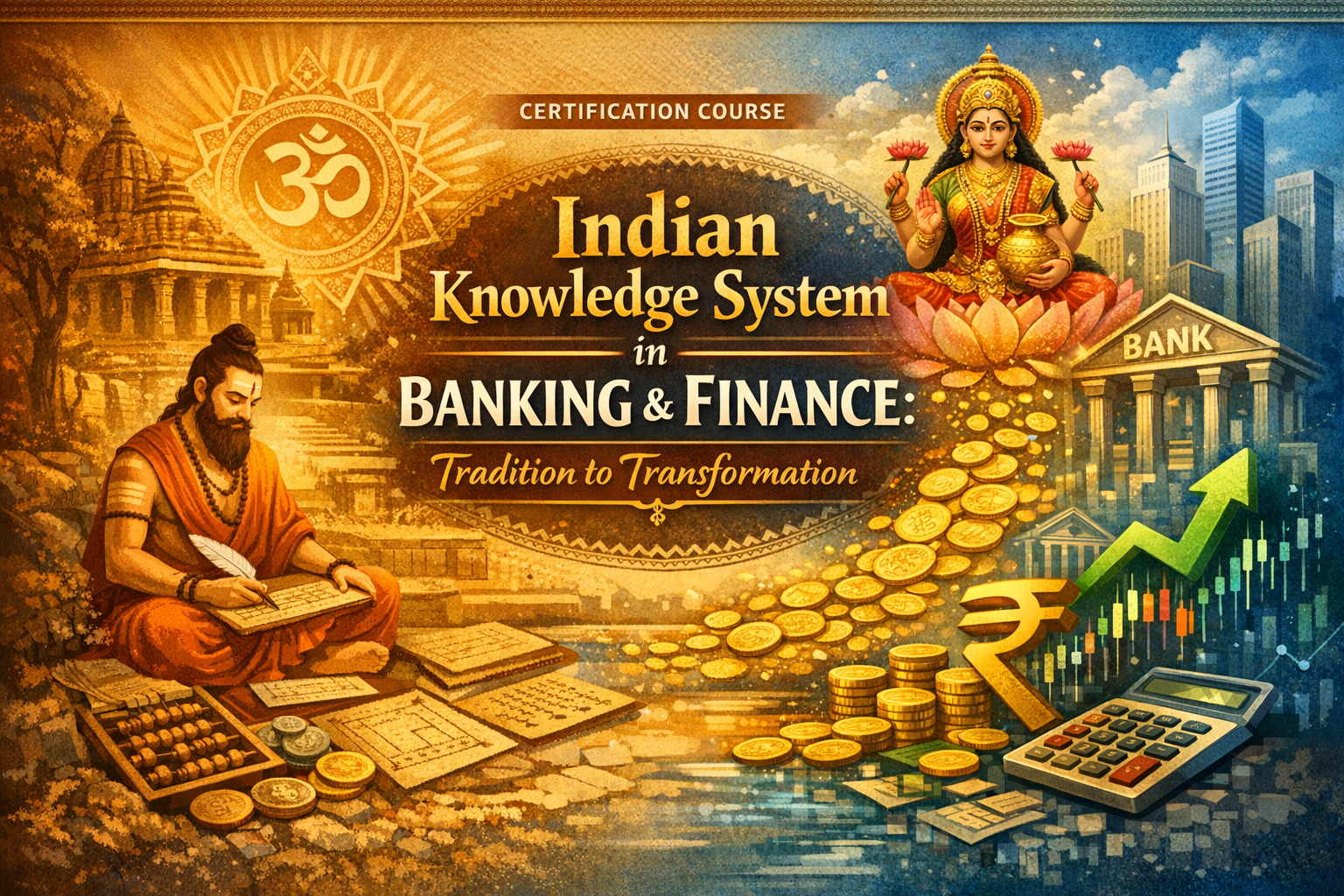
Overview
This course explores the intersection of India’s rich intellectual heritage and contemporary banking practices, offering a multidisciplinary perspective on financial systems. Drawing insights from classical texts such as the Arthashastra, the program examines ancient principles of taxation, treasury management, trade regulation, and ethical governance, and evaluates their relevance in today’s dynamic financial ecosystem. The course further traces the evolution of banking in India, highlighting the role of institutions like the Reserve Bank of India in regulating monetary policy and ensuring financial stability. It integrates traditional knowledge frameworks with modern innovations, including digital payments systems developed by the National Payments Corporation of India, such as UPI and mobile banking platforms.
Our Trainers

Shrashti Gautam
This module provides a foundational understanding of the Indian Knowledge System (IKS), emphasizing its philosophical, economic, and governance-oriented dimensions. It explores the holistic nature of traditional Indian thought, where knowledge is interconnected across disciplines such as economics, polity, ethics, and social organization.
The module introduces learners to classical sources like the Arthashastra, highlighting its insights into statecraft, taxation, financial administration, and economic regulation. Students will examine how ancient Indian scholars conceptualized wealth creation, resource allocation, and ethical governance, forming early frameworks of financial management.
| Date | Time | Trainer | Topic | Description |
| 3/08/2026 | 1:00-2:00PM | Ms. Shrashti Gautam | Intoduction to IKS , Arthashastra & Financial administration | Meaning, scope, and evolution of IKS Key features: holistic approach, ethics, sustainability Overview of ancient Indian economic thought Study of Arthashastra and other classical texts Relevance of IKS in modern financial systems |

Dr. Bhawna sharma
This module traces the historical evolution of banking in India, examining its transformation from indigenous financial practices to a structured and regulated modern banking system. It begins with an overview of early banking functions performed by merchants, moneylenders, and indigenous bankers (such as shroffs and sahukars), who facilitated credit, deposits, and trade financing in pre-colonial India.
The module then explores the development of formal banking during the colonial period, including the establishment of presidency banks and the emergence of joint-stock banks. It analyzes key milestones such as the formation of the Imperial Bank of India and its eventual transformation into the State Bank of India, marking a significant step toward organized banking.
| Date | time | trainer | title | description |
| 4/08/2026 | 1:00-2:00PM | Dr. Bhawna Sharma | Evolution of Banking in India | Understand the stages in the evolution of banking in India Analyze the role of indigenous banking systems in early financial development Examine key milestones in colonial and post-independence banking Evaluate the role of the Reserve Bank of India in financial regulation Assess the impact of reforms and technological advancements on banking growth |

Dr. Manorama Singhade
This module examines the principles and practices of taxation and treasury management in ancient India, with a primary focus on insights derived from the Arthashastra by Kautilya. It provides a comprehensive understanding of how the state generated revenue, managed public funds, and ensured financial stability through systematic and well-regulated mechanisms.
The module explores various sources of state revenue, including land tax, trade duties, customs, fines, and income from state-owned enterprises. It highlights the principles of fair and efficient taxation, where taxes were designed to be proportionate, non-exploitative, and conducive to economic growth. Emphasis is placed on the idea that taxation should not burden citizens excessively but should support welfare-oriented governance.
| Date | time | Trainer | Title | Description |
| 5/08/2026 | 1:00-2:00PM | Dr. Manorama Singhade | Taxation and Treasury Management | Understand the structure and sources of taxation in ancient India Analyze principles of fair and efficient tax systems Examine treasury organization and financial administration Evaluate roles of financial officials and control mechanisms Relate ancient taxation and treasury practices to modern public finance systems |

Dr. Priya Pancholi
This module explores the framework of trade and economic regulation in ancient India, primarily based on the principles outlined in the Arthashastra by Kautilya. It provides a detailed understanding of how markets were organized, monitored, and regulated to ensure fairness, efficiency, and economic stability.
The module examines the structure of internal and external trade, including the movement of goods, trade routes, and the role of merchants and guilds. It highlights the state’s active involvement in regulating commerce through designated officials such as the Superintendent of Trade (Panyadhyaksha), who was responsible for overseeing pricing, preventing malpractices, and ensuring standardization of weights and measures.
| Date | Time | Trainer | Title | Description |
| 6/08/2026 | 1:00-2:00PM | Dr. Priya Pancholi | Trade and Economic Regulation | Understand the structure of trade and commerce in ancient India Analyze regulatory mechanisms governing markets and pricing Examine the role of state officials in trade supervision Evaluate measures for consumer protection and ethical trade Relate ancient trade regulations to modern economic policies and frameworks |

CS Chitra Shridhar
This module examines the ethical foundations and governance principles underlying financial systems, drawing significant insights from the Arthashastra by Kautilya. It focuses on the moral dimensions of economic decision-making and the role of ethical conduct in ensuring transparency, accountability, and sustainability in financial administration.
The module explores how ancient Indian governance emphasized dharma (righteous duty) as a guiding principle in financial practices, ensuring that wealth creation and distribution were aligned with societal welfare. It highlights strict administrative controls, codes of conduct for officials, and well-defined accountability mechanisms designed to prevent corruption, fraud, and misuse of public funds.
| Date | Time | Trainer | Title | Description |
| 7/08/2026 | 1:00-2:00PM | CS Chitra Shridhar | Ethics and Governance in Finance | Understand ethical principles in financial administration from ancient Indian texts Analyze governance mechanisms for transparency and accountability Examine anti-corruption measures and administrative controls Evaluate the role of ethics in modern banking and financial systems Apply ethical and governance principles to contemporary financial practices |

Ms. Ratna Raghuwanshi
This module explores the convergence of traditional banking systems with modern financial technologies (FinTech), highlighting how innovation is transforming the delivery, accessibility, and efficiency of financial services. It examines the shift from conventional branch-based banking to digital, platform-driven ecosystems powered by data analytics, artificial intelligence, and mobile technologies.
The module focuses on the role of institutions such as the Reserve Bank of India in regulating digital banking frameworks and ensuring financial stability, security, and consumer protection in a rapidly evolving technological environment. It also studies the contribution of the National Payments Corporation of India in revolutionizing digital payments through systems like UPI, IMPS, and RuPay, which have significantly enhanced financial inclusion and real-time transaction capabilities.
| Date | Time | Traine | Title | Description |
| 8/08/2026 | 1:00-2:00PM | Ms. Ratna Raghuwanshi | Modern Banking and FinTech Connection | Understand the evolution and scope of FinTech in modern banking Analyze the role of RBI and NPCI in digital financial regulation Examine key digital payment systems and banking innovations Evaluate risks related to cybersecurity and data privacy Assess the impact of FinTech on financial inclusion and banking efficiency |
Modules
- Introduction to Indian Knowledge Systems
- Evolution of Banking in India
- Arthashastra & Financial Administration
- Taxation & Treasury Management
- Trade & Economic Regulation
- Ethics & Governance in Finance
- Modern Banking & Fintech Connections
Outcomes
- Gain knowledge of traditional Indian financial systems
- Understand modern banking through historical context
- Develop ethical financial decision-making skills
- Enhance academic and professional credentials
FAQs
Q1. Is this course beginner-friendly?
Yes, it is suitable for students and professionals with basic interest in finance.
Q2. Will I get a certificate?
Yes, a certificate will be provided after successful completion.
Q3. What is the mode of learning?
Online (Live + Self-paced).
Q4. What is the duration?
1 Week.