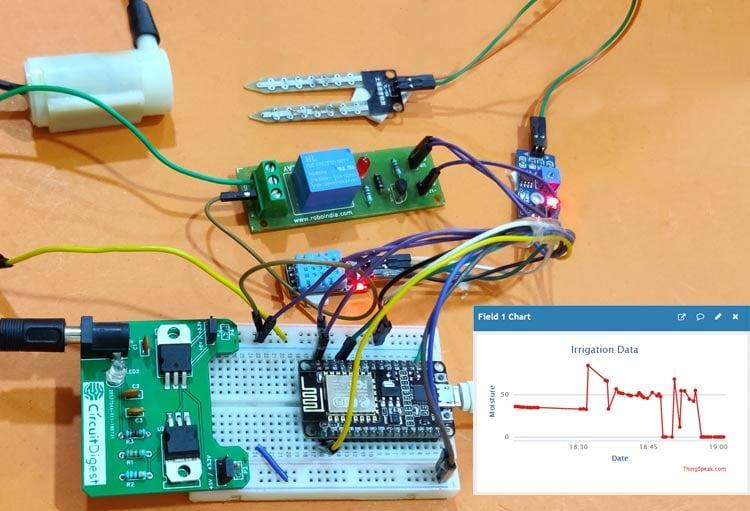
Overview
This course provides a comprehensive introduction to the Internet of Things (IoT), focusing on both conceptual understanding and practical implementation using the ESP8266 (NodeMCU) platform. It is designed to equip students with the skills required to build smart, connected systems by integrating hardware, software, and cloud technologies.
Students will begin with the fundamentals of IoT architecture, including sensors, actuators, microcontrollers, and communication protocols. The course emphasizes hands-on learning, where learners will interface various sensors (such as temperature, humidity, motion, and light sensors) with NodeMCU to collect real-time data.
Further, students will explore wireless communication using Wi-Fi, enabling devices to send and receive data over the internet. The course also covers cloud integration, where students will learn to store, visualize, and analyze data using IoT platforms and dashboards.
By the end of the course, students will design and develop real-world IoT applications such as smart home automation systems, environmental monitoring systems, and remote-controlled devices. This course enhances practical skills in embedded systems, programming, and IoT system design, preparing students for industry-oriented projects and innovations.
Our Trainers

Mr. Abhigyanam Giri
Mr. Abhigyanam Giri is a skilled IoT & Embedded Design Engineer with expertise in designing and developing intelligent systems that integrate hardware and software. Currently working at Indeyes Infotech Pvt. Ltd., he specializes in embedded systems, Internet of Things (IoT) solutions, sensor integration, and real-time device communication.
With a strong foundation in electronics and programming, he has contributed to the development of innovative, scalable, and efficient smart solutions across various domains such as automation, smart devices, and industrial applications. His technical proficiency includes microcontrollers, PCB design, firmware development, and IoT-based cloud integration.
Mr. Giri is passionate about emerging technologies and actively engages in knowledge sharing through workshops, expert talks, and training sessions, helping students and professionals understand practical applications of IoT and embedded systems.
Modules
Module 1: Introduction to IoT
- What is IoT
- Applications of IoT
- Real-world examples
Module 2: ESP8266 (NodeMCU) Basics
- Microcontroller overview
- ESP8266 architecture
- Arduino vs ESP8266
Module 3: Sensor Interfacing
- Temperature sensor (DHT11)
- Ultrasonic sensor
- Light sensor (LDR)
Module 4: Programming & Connectivity
- Arduino IDE setup
- Wi-Fi connectivity
- Data transmission
Module 5: IoT Projects
- Smart Home Automation
- Temperature Monitoring System
- IoT-based Alert System
Outcomes
After completing this course, learners will:
- Understand IoT architecture and concepts
- Work with ESP8266 and sensors
- Build real-time IoT applications
- Develop smart automation projects
- Gain industry-relevant practical skills
FAQs
Q1. Do I need prior programming knowledge?
Basic knowledge is helpful but not mandatory.
Q2. Will I get a certificate?
Yes, a certificate will be provided after completion.
Q3. Is this course practical?
Yes, it is fully hands-on with real projects.
Q4. What tools are required?
ESP8266 (NodeMCU), sensors, laptop with Arduino IDE.