Overview
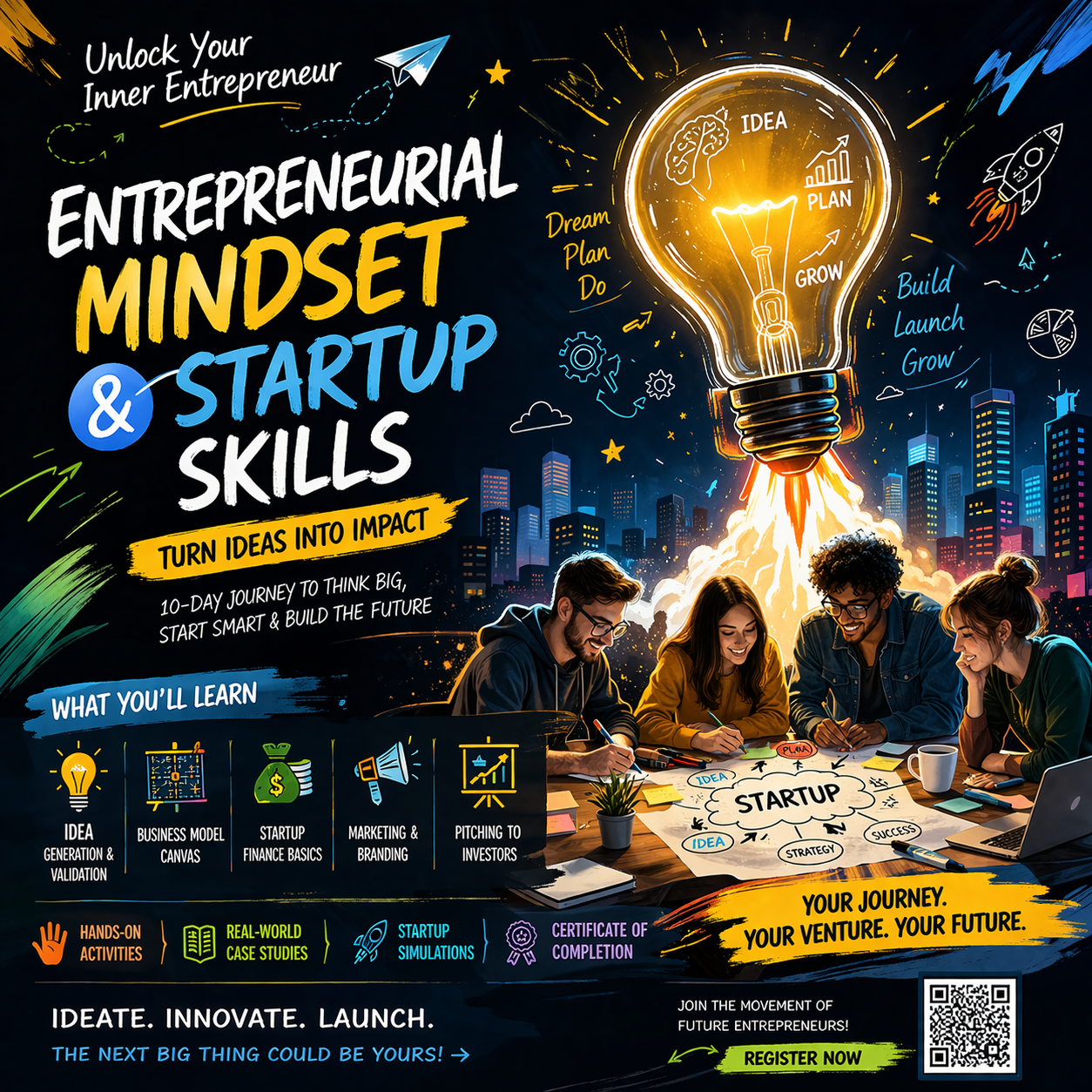
The Entrepreneurial Mindset and Startup Skills course focuses on developing innovative thinking, opportunity recognition, and practical business competencies among learners. It equips participants with the ability to generate and validate ideas, design business models, and understand financial, marketing, and operational aspects of startups. The course emphasizes creativity, risk-taking, resilience, and problem-solving to foster an entrepreneurial attitude. Through experiential learning, case studies, and project-based activities, learners gain confidence to launch and manage ventures effectively. Overall, the program enhances employability, encourages self-reliance, and prepares individuals to contribute to economic growth by creating sustainable and scalable business solutions.
Our Trainers

CS Dr Dipti Sharma
CS Dr. Dipti Sharma
A seasoned academician and industry professional with over a decade of experience in Law, Finance, and Management, Dr. Dipti Sharma holds a Ph.D. in management and is a qualified company secretary. Her research expertise lies in Digital and Financial Literacy and investment behavior, with multiple publications in reputed journals. She has taught at prestigious institutions including Jaipuria Institute of Management, NMIMS, DAVV, Prestige, and ICSI, and has also served in corporate roles at NSDL, Hindalco, Aditya Birla Group, among others. Known for bridging academic theory with industry practice, she is a sought-after keynote speaker, consultant, and examination expert.
Modules
Day 1: Introduction to Entrepreneurship
* Meaning, importance, and types of entrepreneurship
* Role of startups in economic development
* Traits of successful entrepreneurs
Activity: Self-assessment of entrepreneurial traits
Day 2: Developing Entrepreneurial Mindset
* Growth mindset vs fixed mindset
* Creativity and opportunity recognition
* Risk-taking and resilience
Activity: Case discussion on successful startups
Day 3: Idea Generation and Validation
* Techniques for idea generation (brainstorming, SCAMPER)
* Identifying market gaps
* Concept validation and feasibility
Activity: Generate and present 2 start-ups ideas
Day 4: Business Model Development
* Introduction to Business Model Canvas (BMC)
* Value proposition design
* Customer segments and channels
Activity: Create a basic BMC
Day 5: Market Research and Customer Discovery
* Primary and secondary research
* Understanding customer needs
* Competitor analysis
Activity: Conduct mini market survey
Day 6: Startup Planning and Strategy
* Business plan essentials
* Vision, mission, and objectives
* Competitive strategies
Activity: Draft a startup plan outline
Day 7: Financial Basics for Startups
* Costing, pricing, and budgeting
* Sources of finance (bootstrapping, angel investors, venture capital)
* Break-even analysis
Activity: Simple financial plan preparation
Day 8: Legal and Operational Aspects
* Forms of business ownership
* Registration and compliance basics
* Intellectual Property Rights (IPR)
Activity: Identify legal structure for startup idea
Day 9: Marketing and Pitching Skills
* Branding and digital marketing basics
* Sales strategies
* Pitch deck preparation
Activity: Create and present a pitch
Day 10: Startup Launch and Growth
* Scaling strategies
* Challenges faced by startups
* Failure management and learning
Activity: Final startup presentation (QUIZ)
Outcomes
1. Develop an entrepreneurial mindset and identify opportunities
2. Create and validate business ideas
3. Design a business model and basic startup plan
4. Understand financial, legal, and marketing aspects
5. Present and pitch a startup idea effectively
FAQs
1. Who should take this course?
This course is ideal for aspiring entrepreneurs, students, startup enthusiasts, and professionals who want to develop innovative thinking and business skills.
2. Do I need prior business knowledge?
No, the course is designed for beginners as well as those with basic knowledge of business concepts.
3. What skills will I gain from this course?
You will learn opportunity recognition, idea validation, business model development, financial planning, marketing strategies, and pitching skills.
4. Is this course theoretical or practical?
The course emphasizes practical learning through case studies, real-world examples, and project-based activities.
5. Will I be able to start my own business after this course?
Yes, the course provides the foundation and tools needed to transform ideas into viable business ventures.