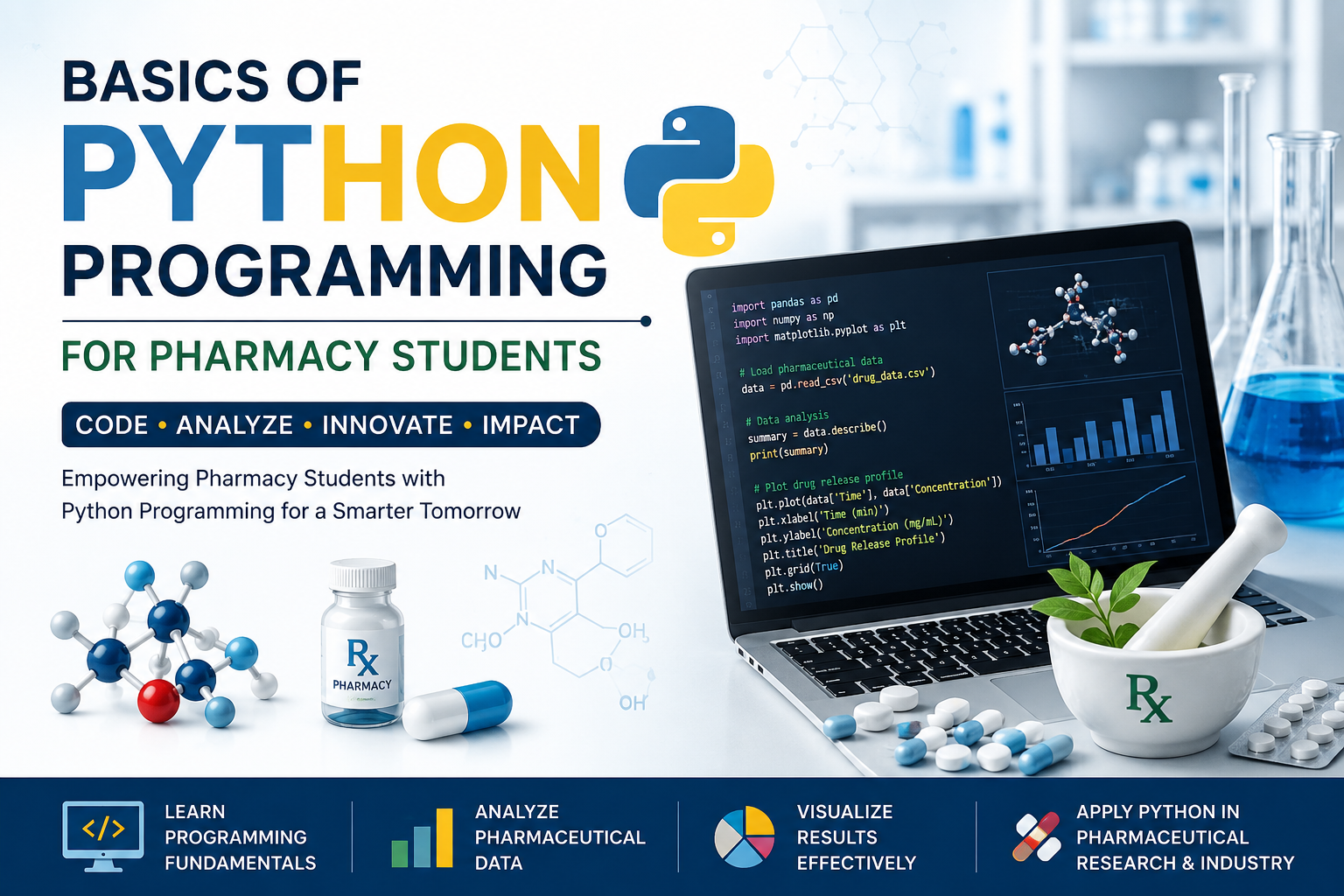
Overview
The pharmaceutical sector is increasingly adopting digital technologies, artificial intelligence, bioinformatics, and data analytics. Python has emerged as one of the most popular programming languages due to its simplicity, versatility, and extensive applications in scientific computing.
This Summer School course aims to equip Pharmacy students with basic programming skills and introduce them to computational approaches used in modern pharmaceutical sciences. Students will learn Python syntax, data structures, file handling, data visualization, and introductory pharmaceutical data analysis. The course emphasizes practical learning through exercises and mini-projects relevant to pharmacy and healthcare domains.
By the end of the course, participants will be able to write simple Python programs, analyze pharmaceutical datasets, visualize scientific data, and appreciate the role of programming in research, industry, and healthcare innovation.
Our Trainers

Modules
Course Modules
Module 1: Introduction to Python Programming and Pharmacy Applications
- Overview of programming concepts
- Importance of Python in pharmaceutical sciences
- Installation and setup of Python environment
- Python syntax, variables, and data types
- Input and output operations
Module 2: Decision Making and Looping Constructs
- Arithmetic, relational, and logical operators
- Conditional statements (if, elif, else)
- Looping structures (for and while loops)
- Control statements (break, continue, pass)
- Problem-solving exercises
Module 3: Python Data Structures
- Lists and list operations
- Tuples and sets
- Dictionaries and their applications
- String manipulation
- Pharmaceutical data organization using data structures
Module 4: Functions and File Handling
- Creating and using functions
- Function arguments and return values
- Modular programming concepts
- Reading and writing files
- Handling CSV files for research data management
Module 5: Data Analysis Using NumPy and Pandas
- Introduction to NumPy arrays
- Data manipulation using Pandas DataFrames
- Importing and cleaning datasets
- Basic statistical analysis
- Applications in pharmaceutical and healthcare data
Module 6: Data Visualization and Pharmacy Case Studies
- Introduction to Matplotlib
- Creating graphs, charts, and plots
- Visualization of pharmaceutical experimental data
- Python applications in drug discovery, pharmacovigilance, and healthcare analytics
- Mini-project and presentation of findings
Outcomes
Upon successful completion of the course, students will be able to:
- Understand the basic concepts of programming and Python syntax.
- Develop simple Python programs using variables, operators, loops, and functions.
- Utilize Python data structures for organizing and managing pharmaceutical information.
- Perform file handling operations for experimental and research data.
- Analyze and manipulate datasets using NumPy and Pandas libraries.
- Create meaningful visualizations for pharmaceutical and healthcare data.
- Apply basic programming skills to solve pharmacy-related problems.
- Recognize the role of computational tools in pharmaceutical research, industry, and healthcare.
FAQs
Eligibility: B.Pharm, Pharm.D, M.Pharm students and research scholars
Mode: Online
Prerequisite: No prior programming knowledge required.